

Table of Contents
What if the very supplement meant to protect your child becomes a hidden danger? Every parent knows this tension. You buy gummy vitamins to solve a problem. You have a picky eater or a child who can’t swallow pills. But the very thing that makes them work creates a real risk. They taste like candy. A kid sees colorful, fruity shapes and thinks “treat,” not “supplement.” I understand. I turned to gummies after my own pill fatigue. But when I saw my nephew eye my bottle like it was gummy bears, reality hit. Getting the right children’s gummy vitamin dosage is a fine line between nutrition and temptation.
The data backs this up. Last year, the CDC warned that gummy supplements‘ appealing flavors and shapes raise the risk of accidental overdose in kids. Industry guidelines from the Council for Responsible Nutrition (CRN) also note their candy-like look can lead to unsupervised access. So you’re not overthinking it. That nagging feeling is real.
Let me be clear. I’m not here to scare you off gummies. For many kids, they’re the only way to get crucial nutrients consistently. The solution isn’t to ditch them. It’s to use them smarter. This article is your safety-first guide. We’ll move past fear into practical action. You’ll get a simple 3-part audit for any bottle. Plus, a clear age-based children’s gummy vitamin dosage guide.
Think of this as moving from worry to a plan. Keep reading to learn how to protect your child while using these helpful tools.
Are Gummy Vitamins Safe? The Children’s Gummy Vitamin Dosage Answer

Here’s the truth. A child isn’t a miniature adult. Giving “half an adult dose” isn’t safe. It’s a gamble with their developing body. Their smaller bodies process nutrients differently. They have immature organs and a faster metabolism. That makes precise, age-calibrated children’s gummy vitamin dosage essential.
I once reviewed a multivitamin where a parent gave their 8-year-old half a teen gummy. “It’s basically the same, right?” she asked. My heart sank. That logic ignores pediatric biology. As Fermentis Life Sciences noted in a June 2025 industry publication, children need doses set for specific age groups. They should not be given rough fractions.
This need for precision comes from three key differences:
- Organ Development: A child’s liver and kidneys are still maturing. They can’t process and clear extra nutrients as well as an adult’s can.
- Metabolic Rate: Kids burn energy faster. This affects how they use vitamins and minerals. They can also be overwhelmed more easily.
- Body Surface Area: Dosage isn’t just about weight. It often uses body surface area, which better reflects a child’s metabolic capacity.
Fat-Soluble Vitamin Risks in Children
This is where things get serious. You need to know the difference between water-soluble and fat-soluble vitamins.
- Water-soluble (like Vitamin C & B vitamins): Your body flushes out the excess through urine. Mega-doses can upset your stomach. The risk of long-term toxicity is lower.
- Fat-soluble (Vitamins A, D, E, & K): These get stored in your body’s fat and liver. They don’t flush out easily.
Because they’re stored, megadoses can cause toxicity. The American Academy of Pediatrics warns about this. A consistent, moderately high intake from a poorly-dosed gummy can build up over weeks or months. This can lead to health issues. Vitamin D is a classic example. It’s critical for bones, but dangerous in excess.
So, “kid-sized” isn’t a cute marketing term. It’s a necessary design. When you look at a bottle, you’re not just looking for a smaller gummy. You’re looking for a formula that respects a growing body’s science.
Hidden Risks in Sweet Gummy Vitamins
When we talk about sugar in gummies, we usually just count grams. But the real issue isn’t always the sugar. It’s what else makes them sweet, chewy, and shelf-stable. Ingredients like sugar alcohols and other fillers are common. They can turn a standard dose into a digestive problem for a small child.
A child’s digestive system is more sensitive. Sorbitol gives a gummy its pleasant chew. It’s also an osmotic agent. It draws water into the gut. In small adult doses, it’s often fine. But in the amount a child might get from two or three gummies, it can cause bloating, gas, and diarrhea. I’ve tasted gummies where the waxy aftertaste and sudden stomach issues made the serving size feel like a warning.
This ties directly to dosing. If the serving is two gummies, you’re giving a dose of vitamins and a dose of these digestive irritants. A SingleCare article from 2022 even notes gummies may sometimes have unlisted ingredients. That’s unsettling when you’re calculating what a 30-pound body can handle.
Then there’s texture. This is a safety issue disguised as a quality one. A gummy that’s too hard or too sticky can be a choking hazard for little ones. The Council for Responsible Nutrition (CRN) guidelines warn that gummies can be a choking risk for children under four. This risk is present if the gummy is not chewed completely. That’s hard to guarantee with a toddler. A “perfect” children’s gummy vitamin dosage is useless if the gummy itself is risky.
So look beyond sugar grams. Scan for sorbitol, maltitol, and xylitol. Think about the texture in your child’s hands, not just your own. The goal is nourishment, not a surprise digestive experiment. Understanding these gummy vitamin side effects is key.
Children’s Gummy Vitamin Dosage: A 3-Step Safety Check
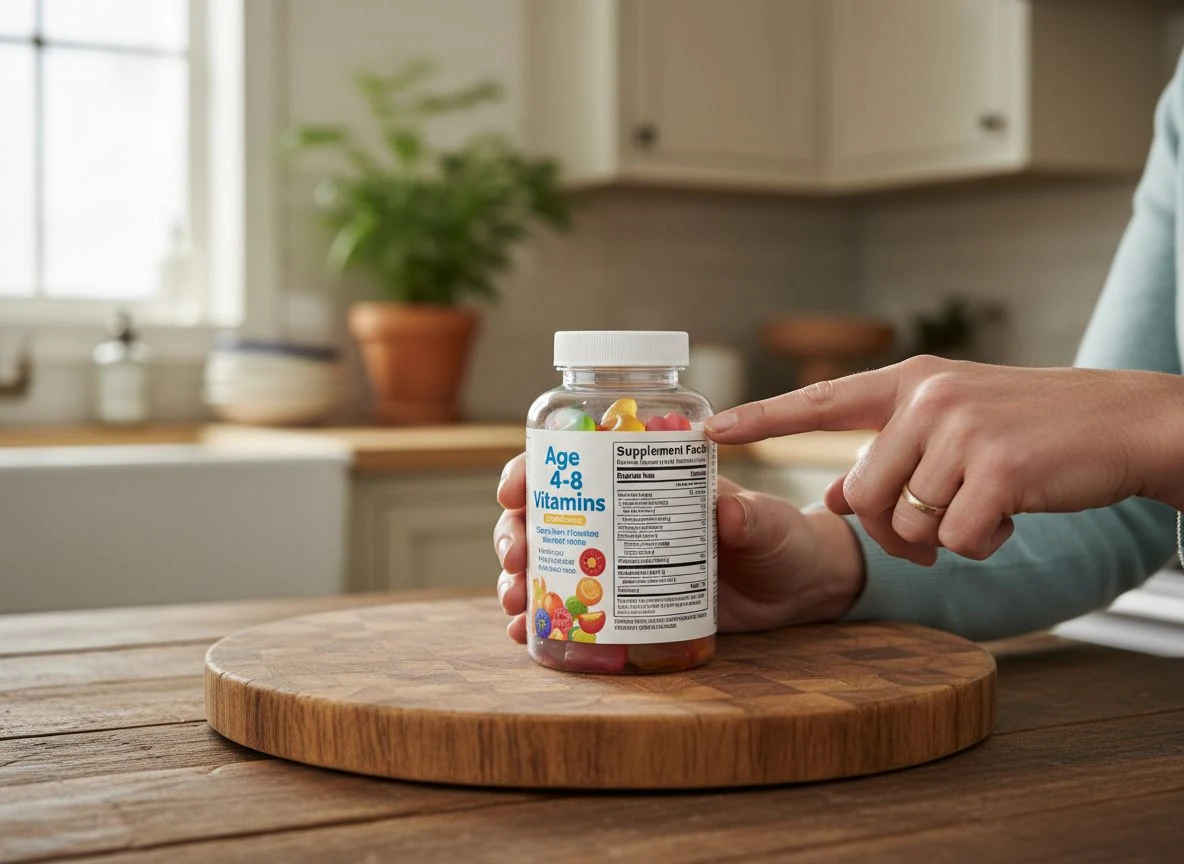
Here’s your action plan. Before giving your child any gummy, take two minutes with the bottle. Do this three-step audit. It moves you from “for kids” to “right for my 7-year-old.” Grab the bottle you’re considering. Or grab the one in your cabinet. Let’s start.
Decode the Supplement Age Range First
First, find the suggested age on the label. This seems obvious. But here’s the critical question: Is this a precise range or a marketing catch-all?
I’ve seen bottles that say “For Kids 2+” and others that say “Formulated for Children 4-8 Years.” The first is a red flag. A two-year-old and a twelve-year-old have very different needs. A broad range often means the formula is a compromise. It’s not a precise dose.
Audit Question: Does the age range match my child’s specific age, or is it so broad it’s meaningless?
Compare Serving Size to Daily Values
Next, look at the Supplement Facts panel. Pick a key nutrient. Vitamin D is perfect. Check the amount per serving (like 25 mcg or 1000 IU). Now, cross-reference it with the Recommended Dietary Allowance (RDA) for your child’s exact age.
Let’s use clear guidelines. The target is 400 IU for infants under 1 year, 600 IU for children over 1 year. If your 5-year-old’s gummy gives 1000 IU per serving, that’s 167% of their RDA in one gummy. That’s a big jump for a fat-soluble vitamin stored in their body. This is a core part of safe children’s gummy vitamin dosage.
Audit Question: Does the dose for key nutrients (especially A, D, E, K) reasonably match my child’s age-specific RDA, or does it wildly exceed it?
Check for Nutrient Overlap Risks
This is the step most parents miss, and it’s crucial. You must account for total intake. A gummy isn’t given in a vacuum.
Is your child already eating fortified cereal? Drinking milk with added Vitamin D? Having a daily probiotic gummy? Many kid-foods are fortified. Do a quick mental tally. See if the gummy’s dose, plus their diet and other supplements, risks hitting the Tolerable Upper Intake Level (UL).
Audit Question: Considering my child’s entire diet and supplement routine, does this gummy create a potential for nutrient overload?
This audit isn’t about finding “bad” products. It’s about finding the right product for your individual child. It turns a scary guess into a simple, informed check. This is a vital part of learning how to choose gummy vitamins.
Safe Vitamin Dosages by Age Group
Here’s the core truth most gummy labels hide. “safe for kids” isn’t one standard. It’s a three-part equation. It includes your child’s exact age, the specific nutrient, and its Tolerable Upper Intake Level (UL). Miss one, and you risk going into unsafe territory.
I learned this the hard way. I once calculated a child’s total Vitamin A from cereal, carrots, and a “kids multivitamin” gummy. The daily total sailed past the UL for their age. It was a quiet overdose, hidden in a “healthy” day. That’s the silent risk with fat-soluble vitamins. They build up.
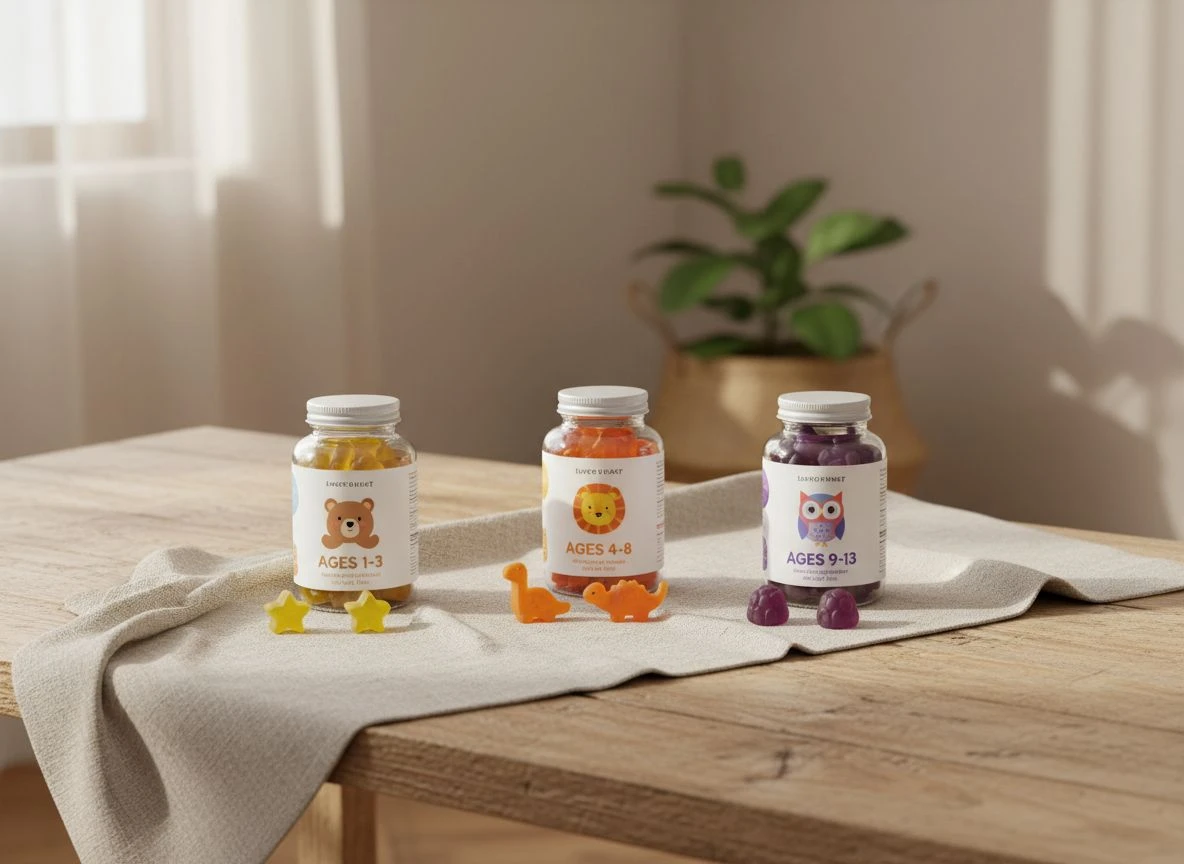
That’s why I now use a simple matrix. It’s not about fear. It’s about giving you the same tool pediatric nutritionists use. You’ll notice precise brands like Miduty base formulas on standards like the ICMR-NIN RDA 2020. Others, like Little Joys, mention “Upper Limits” in their guides. This is the benchmark.
| Nutrient | Age 1-3 Years | Age 4-8 Years | Age 9-13 Years |
|---|---|---|---|
| Vitamin A (RAE) | RDA: 300 mcg | RDA: 400 mcg | RDA: 600 mcg |
| UL: 600 mcg | UL: 900 mcg | UL: 1700 mcg | |
| Vitamin D (IU) | RDA: 600 IU | RDA: 600 IU | RDA: 600 IU |
| UL: 2500 IU | UL: 3000 IU | UL: 4000 IU | |
| Zinc (mg) | RDA: 3 mg | RDA: 5 mg | RDA: 8 mg |
| UL: 7 mg | UL: 12 mg | UL: 23 mg | |
| Iron (mg) | RDA: 7 mg | RDA: 10 mg | RDA: 8 mg (boys) / 15 mg (girls) |
| UL: 40 mg | UL: 40 mg | UL: 40 mg |
Source: National Institutes of Health, Dietary Reference Intakes.
How to use this: When you audit a label, find the nutrient amount per serving. Check it against the RDA for your child’s age. That’s the “adequate intake” target. Then, crucially, check it against the UL. This is the absolute ceiling not to exceed from all sources combined, including food. The American Academy of Pediatrics (AAP) warns that exceeding ULs can cause nausea, rashes, and headaches. This is especially true for vitamins A, C, or D. If one gummy gives 80% of the UL for Vitamin A, you’re playing Jenga. This game is with their nutrition for the rest of the day. Understanding this table is key to correct children’s gummy vitamin dosage.
FAQ:
Q: What if my child’s gummy provides more than the RDA?
A: That’s common. But you must check the UL. A little over the RDA is often fine. But you need room below the Upper Limit for dietary intake. If the gummy dose plus a typical diet comes close to the UL, that product is dosed too high. It is not safe for daily use.
Q: Are Upper Limits for vitamins immediate toxicity thresholds?
A: Not exactly. The UL is the maximum daily intake unlikely to cause problems over time. Regularly bumping against it isn’t wise, even without immediate symptoms. Chronic low-level overconsumption is the real, hidden concern.
Recognizing Gummy Vitamin Overdose Symptoms
A gummy overdose is a poison emergency, not a simple bellyache. This is the most important sentence here. If you think your child ate too many gummy vitamins, call Poison Control at 1-800-222-1222 immediately. Don’t Google. Don’t wait. Call. This is the directive from the CDC and every medical resource for a reason.
Symptoms start with stomach trouble. These include nausea, vomiting, and diarrhea. Experts like SingleCare outline this. But with fat-soluble vitamins (A, D, E, K), the risks are worse. A megadose of Vitamin A can cause dizziness, blurry vision, and liver damage. Too much Vitamin D leads to high calcium. This causes weakness, confusion, and kidney issues. In severe, untreated cases, organ failure is possible.
Here’s your action plan:
- Call 1-800-222-1222. Have the supplement bottle in your hand. Tell them the brand, nutrient list, and your best guess of how many were eaten.
- Follow their instructions exactly. They will tell you what to do. Never induce vomiting unless a medical professional specifically tells you to.
- Go to the ER if told to do so. Bring the bottle with you.
The scary part of a gummy overdose is that it looks like innocent snacking. That’s why you must treat every bottle like medicine. Lock it up, keep it out of reach, and never call it “candy.” It’s your best defense.
Essential Rules for Storing Kids’ Vitamins
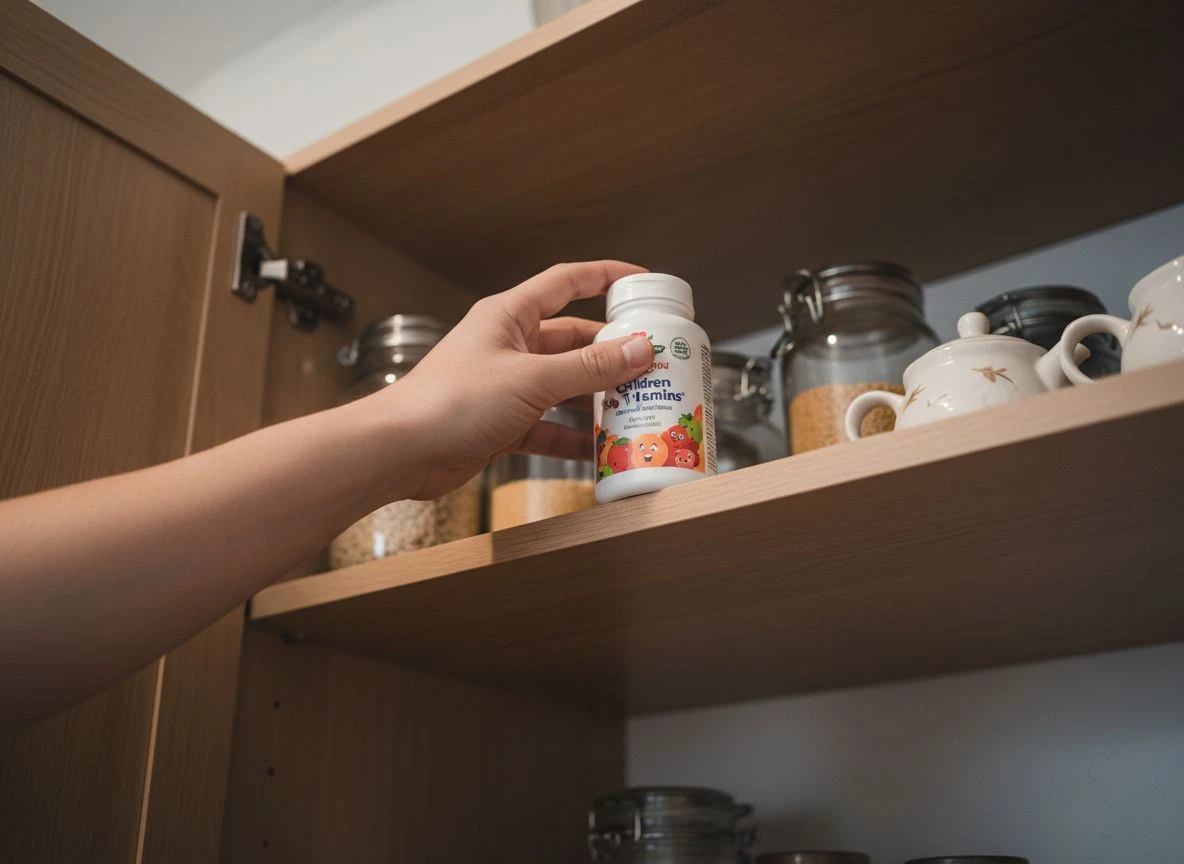
This is about behavioral dosing. The most perfect gummy is a hazard if you treat it like a snack. Safety isn’t just about what’s in the gummy. It’s about how you store, talk about, and give it. Your mindset must shift from “vitamin” to “medicine.”
The rules are absolute. First, storage. The CDC says keep all supplements “up and away” in their original, child-resistant containers. I keep my test bottles locked up. Never transfer gummies to baggies, pill organizers, or candy jars. Consumer Med Safety specifically warns against this. It removes the child-resistant cap. This makes them look even more like treats.
Second, language and ritual. Never call them “candy” or use them as a reward. The CDC advises this. You give the dose yourself, every time, from the locked bottle. Then the bottle goes immediately back up high. This consistent, boring ritual teaches your child this is a health product, not a treat. It’s the most important supplement habit you’ll build. For more, see our guide on how to store gummy vitamins.
Creating a Supplement Plan with a Pediatrician
Here’s the honest summary. A great strategy starts by seeing a gummy as a potential tool, not a necessity. Your job is to be the informed manager. Your pediatrician is the essential consultant you bring in before finalizing any plans.
Now you have the audit framework and safety mindset. You’re no longer just buying a bottle off the shelf. You’re evaluating a product against your child’s specific age, diet, and needs. Have this exact conversation with your pediatrician. Bring the bottle (or label details) to your next visit. Ask: “Given my child’s diet and health, does this product’s nutrient profile and children’s gummy vitamin dosage make sense as targeted support?”
Remember the basic guidance. Healthy kids on balanced diets may not need any supplements. Your pediatrician can help spot real gaps versus marketing hype. This collaborative review turns a guessing game into a smart decision. It’s how you find the truly best gummy vitamins for kids.
So, use gummies wisely if you and your doctor agree they help. Treat them with the respect—and locked storage—they require. Let this be your powerful reminder: when in doubt, dose out.

I founded Best Gummy Reviews after discovering shocking quality gaps during my own vitamin D treatment. With 8+ years in nutrition research, I combine lab science with real-world testing to tell you what actually works. I’m thorough but straightforward—supplements should complement your healthy habits, not replace them.