

Table of Contents
Here’s our honest roadmap. We’re moving past the shiny marketing to look at the hard evidence, the big formulation flaws, and the real-world use of beauty gummies. You’ll get a clear view of what the science actually supports and the critical pitfalls most reviews ignore. This guide answers the core question: do beauty gummies work, or are they just candy?
The article will flow like this:
- The Hook: We’ll start by acknowledging the tempting “beauty gummy” promise. Then we’ll state our mission: to replace hype with clarity.
- Collagen Deep Dive: We’ll analyze the promising but nuanced data for collagen. We’ll highlight the big gap between effective oral doses and what a gummy can actually deliver.
- The Gummy Dosage Dilemma: A blunt breakdown of the core math problem. We’ll show why you likely can’t chew a meaningful dose without also eating too much sugar.
- Biotin Myth-Busting: A direct look at the “biotin for hair growth” myth for healthy people. We’ll also give a crucial warning about its dangerous interference with lab tests.
- Smart Consumer Guide: We’ll end with actionable steps. You’ll learn how to evaluate products, prioritize key co-factors (like Vitamin C), and set realistic expectations.
Our goal isn’t to dismiss all beauty gummies. It’s to equip you with the knowledge to find the rare products that might be worth it—and avoid the many that are just expensive, sugary candy. We’re here to find out if beauty gummies work.
The Reality Behind Beauty Gummy Claims

Let’s be real. The promise is irresistible. A tasty, colorful gummy that smooths wrinkles and fuels hair growth from within. It sounds easier than serums and salon visits. It’s wellness wrapped in candy, and we’ve bitten—hard. The market exploded because of it. Consumers spent a staggering 2 billion on collagen supplements in 2025 alone. 29% of us use biotin-containing products, hoping for that “beauty from within” glow.
I’ve tested dozens of these products. Honestly, I wanted them to work. The convenience is a game-changer for consistency. But after comparing ingredients to clinical research, a frustrating pattern emerged. It’s a pattern of big promises built on shaky foundations, tiny doses, and real health trade-offs.
This article isn’t here to shame anyone for wanting an easy win. It’s here to deconstruct the marketing. We’ll separate the compelling hype from the credible evidence. We’ll break down the three truths most beauty gummy reviews ignore.
First, the physical impossibility of fitting a clinical collagen dose into a few gummies. Second, the dangerous way high-dose biotin can sabotage critical medical lab tests. Third, the ironic “glycation paradox”. That’s where the sugar in your gummy may actively damage the collagen you’re trying to support.
My goal is to replace confusion with clarity. By the end, you won’t just be a consumer. You’ll be an informed skeptic. You’ll be equipped to see past the shiny packaging and make choices that truly align with your health goals. Let’s pull back the curtain.
Collagen Benefits for Skin and Joints Explained
Here’s the quick take. Solid research shows oral collagen peptides can improve skin hydration and elasticity. A meta-analysis of 646 people confirmed real effects. But the clinically effective dose—a median of 3.5 grams daily—poses a massive problem for the gummy format. Study limitations mean the hype still outruns the science.
My own journey into gummies started with classic “pill fatigue.” After years of choking down big capsules for joint support, switching to a chewy collagen gummy felt like a revelation. The consistency was effortless. That is, until I looked at the dose. The two-gummy serving promised “beauty support” but delivered just 1 gram of collagen. My relief at ditching pills turned into skepticism. Where was the rest of the clinical dose?
The science behind collagen itself is sound. It’s the foundational scaffolding of our skin. As we age, our natural production slows. This leads to thinner, drier skin and wrinkles. The theory is that ingesting hydrolyzed collagen peptides could signal our bodies to produce more. It’s a compelling idea—and it’s backed by some decent data.
A robust October 2025 meta-analysis in the Indian Journal of Dermatology, Venereology and Leprology reviewed 10 randomized controlled trials with 646 participants. The findings were significant. Collagen supplementation increased skin hydration and elasticity. The median effective dose across these studies was 3.5 grams per day. Many used a clean 4-gram daily dose. That’s the number to remember.
But. We have to add crucial context that much marketing glosses over. The authors of that meta-analysis noted big limitations. Most studies couldn’t control for weather or climate. That’s huge for skin measurements. The population was almost exclusively female. There was notable variation in the results. Furthermore, a 2026 National Geographic report highlighted that many positive trials are industry-funded. They often include other active ingredients like vitamins C and E. This makes it hard to isolate collagen’s solo effect.
That co-factor point isn’t trivial. Vitamin C and zinc are essential for the enzymes that actually build collagen in your body. A supplement without them is like hiring a construction crew but forgetting to deliver the bricks.
So, we have promising (if imperfect) evidence for a 3.5-4 gram daily dose of collagen. It should ideally be paired with key nutrients. This brings us to the core, practical problem most glossy reviews avoid: the gummy format itself. How do you stuff a meaningful dose of a bulky protein powder into a few tasty, shelf-stable chews? The short answer is, you usually can’t. And that’s where the real breakdown begins.
Do Collagen Gummies Deliver Enough Per Serving?
Here’s the blunt reality. To get a clinically studied dose of collagen from a gummy, you’d need to chew four to seven of them every single day. This isn’t a minor inconvenience. It’s the fundamental flaw that makes most beauty gummies a compromise, not a solution. The math simply doesn’t work for the format.
Let’s break down the manufacturing wall you can’t see. A standard, palatable gummy has a finite physical capacity. Between the gelatin or pectin base, the flavors, colors, and sweeteners, there’s only so much room for the active ingredient. Most gummies max out at holding 500mg to 1 gram (1,000mg) of collagen peptides per piece.

Now, hold that number against the research. As we saw, the median effective dose in the meta-analysis was 3.5 grams daily. Many positive studies used a clean 4-gram dose.
| Clinical Research Dose | Typical Single Gummy | |
|---|---|---|
| Collagen Peptides | 4,000 mg (4 grams) | 1,000 mg (1 gram) |
| # of Gummies Needed | — | 4 gummies |
That’s for a brand using a full gram. Many use only 500mg. That doubles the required number to eight gummies daily. This is the “fairy-dust dosing” problem. They sprinkle in just enough to list it on the label, but not enough to match the science.
The consequence isn’t just swapped fatigue. It’s a massive multiplication of everything else in the formula. If one gummy contains 2-3 grams of sugar, then four gummies deliver 8-12 extra grams of sugar daily. You’re trading a potential skin benefit for a guaranteed metabolic load. Ironically, that sugar promotes the glycation that damages collagen.
From a formulation perspective, this is the gummy’s unsolvable catch-22. To fit a full clinical dose into one or two pieces, you’d need to create a dense, unpalatably large gummy. No one would buy it. So manufacturers choose marketability over optimal dosing. They hope you won’t notice the shortfall. I’ve tested them. The ones claiming “high-potency” blends still land in this 500mg-1g range.
The bottom line is stark. If you are taking collagen gummies, you are almost certainly taking a sub-clinical dose. You might be paying a premium for a format that prevents you from reaching the intake level the evidence supports. It turns “beauty from within” into a puzzle the gummy format can’t solve. So, do beauty gummies work for collagen delivery? The format itself often prevents it.
The Truth About Biotin for Hair and Nails
Here’s the uncomfortable truth. The biotin gummy you’re taking for thicker hair could be masking a serious health problem. It can skew critical lab tests. For the general, healthy population, biotin supplementation is a solution in search of a problem. It’s a brilliant marketing story built on extremely shaky science.
Let’s be real about biotin (vitamin B7). The American Academy of Dermatology states point-blank that biotin deficiency is rare and supplementation is unnecessary for healthy individuals. A 2022 review was even more direct. It concluded there are “no studies demonstrating that biotin supplementation benefits hair growth in healthy individuals.” It’s only essential for those with specific, diagnosed conditions.
Yet, GoodRx notes that roughly 20% of people in the U.S. consume it. They’re lured by glossy before-and-afters. Why? Because it’s abundant in a normal diet. Think eggs, salmon, seeds, and meat. A true deficiency is unlikely for most.
Now, here’s the critical, under-reported pivot. High-dose biotin is notorious for interfering with common lab tests. It can cause falsely high or low results in tests for thyroid function, heart health, and vitamin D. This could lead to misdiagnosis. The FDA has even issued warnings about this risk.
Between you and me, that’s a staggering risk-benefit profile. You’re taking a vitamin you likely don’t need. The benefits aren’t proven for people like you. And there’s a real chance of muddying your vital health data. If you’re considering biotin gummies, talk to your doctor first. Always disclose all supplements before any bloodwork.
Biotin Interference With Blood Test Results
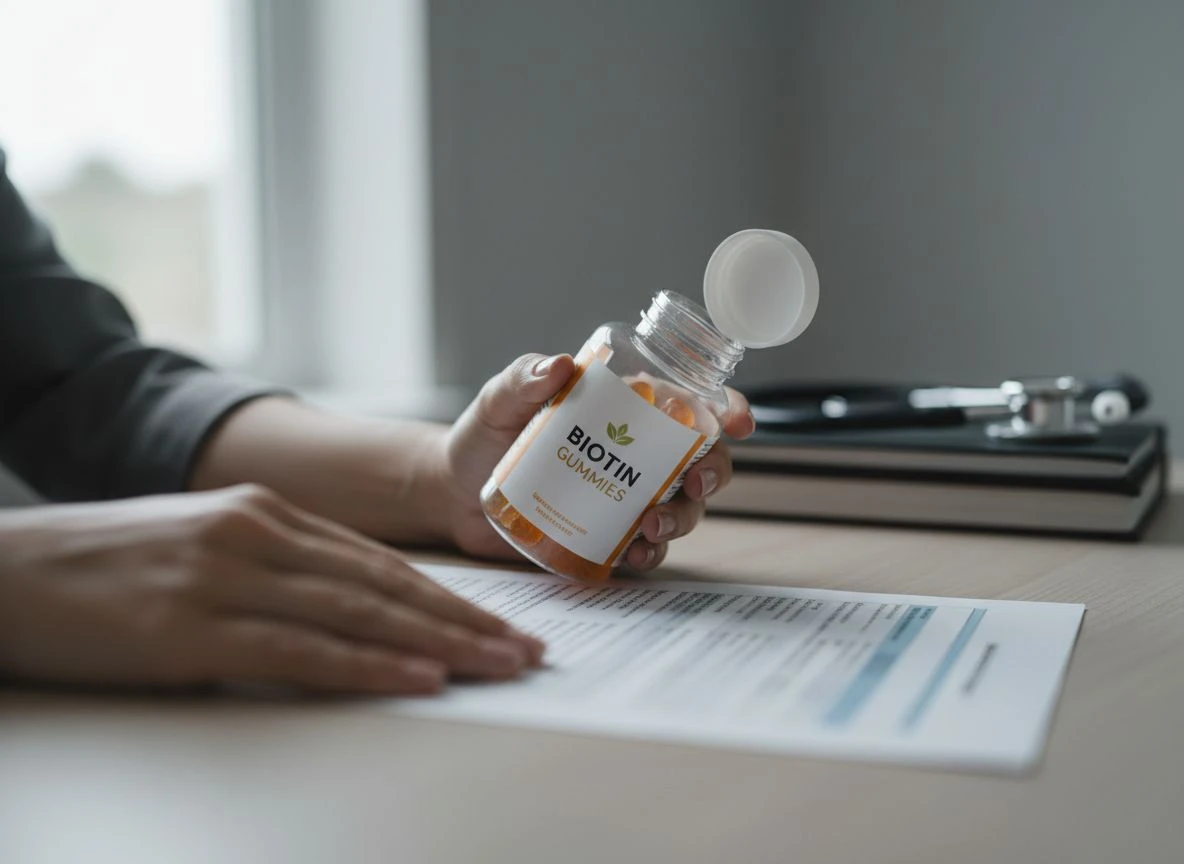
Here’s the most alarming, under-discussed risk. Your biotin gummy can cause critically inaccurate blood test results. It could lead to misdiagnosis or missed emergencies. The mechanism is simple. Many modern lab tests use biotin as part of their detection system. If you’ve consumed a high dose, the extra biotin in your blood can bind to the test reagents. This causes falsely sky-high or plummet-low readings.
Look, this isn’t a theoretical concern. The American Academy of Dermatology explicitly warns that high-dose biotin can interfere with critical lab tests. The implications are staggering. As detailed in a GoodRx health resource, the interference can affect thyroid panels, vitamin D tests, and cardiac troponin tests. Troponin is the key protein used to diagnose a heart attack.
Imagine this. You have unexplained fatigue and get bloodwork. Your thyroid hormone comes back abnormally low. Or worse, you go to the ER with chest pain, but your troponin levels appear normal. In both cases, the result could be a dangerous false reading. It could be caused solely by the “beauty” gummy you took that morning. This could mean no treatment for a real condition or a missed heart attack.
The action step is non-negotiable. Always disclose every supplement you take to your doctor before any bloodwork. Specifically ask if you need to pause your biotin gummy. The standard guidance is to stop high-dose biotin for 3 to 7 days before testing. This allows it to clear your system. It’s a small habit change that could prevent a major medical error.
Sugar in Gummies and Skin Aging Effects
Here’s the brutal, ironic truth. The sugary gummy you’re chewing for collagen might be actively damaging the collagen you already have. This is the glycation paradox. You’re consuming a high-sugar vehicle to fight a process that sugar accelerates. The evidence for glycation is solid. The logic of most beauty gummies is not.
Let me explain glycation simply. When you consume excess sugar, those molecules can bind to proteins like collagen in your skin. This reaction is called glycation. It creates brittle, cross-linked fibers aptly named AGEs (Advanced Glycation End products). These damaged proteins lose their flexibility. This leads to wrinkles, sagging, and advanced aging.
Now, here’s the personal kicker. I’ve watched people skip sugar in their coffee for “skin health,” then mindlessly eat 4-5 beauty gummies. A single gummy can contain 2-4 grams of added sugar. Eat enough to reach a functional collagen dose, and you’re looking at a sugar payload that rivals a small candy bar. The vehicle works against the stated goal.
This isn’t just a theoretical conflict. It highlights the unregulated nature of the “beauty supplement” space. A 2020 NIH study on skin, hair, and nail supplements found widespread use of outdated data and unverified claims. Many products lack independent testing. Brands aren’t required to prove their sugary gummies won’t undermine your skin. Between you and me, that’s a glaring oversight. When evaluating any beauty gummy, the ingredient list matters just as much as the collagen dose—maybe more. This is key to understanding if beauty gummies work as claimed.
A Smart Buyer’s Guide to Beauty Supplements
Here’s the hard truth. The supplement aisle is a minefield of marketing, not medicine. Becoming an informed buyer means learning to ignore the “glow” claims. You need to scrutinize the facts on the label. Your best defense is a systematic checklist.
Look, after testing dozens of products, I’ve developed a failsafe filter. Use this checklist before your next purchase. It will help you avoid wasting money on fairy dust.

Your Beauty Gummy Buyer’s Checklist:
- 1. Prioritize Third-Party Certification. This is non-negotiable. The American Academy of Dermatology advises seeking products verified by independent labs like USP or NSF. This is your only guarantee that what’s on the label is in the bottle. In a market with unverified claims, this seal is your lifeline.
- 2. Do The Simple Math on Collagen Dose. Check the serving size. If a gummy provides 500mg of collagen and the clinical dose is 3,500mg, you need 7 gummies. Now multiply the sugar and cost by seven. Is that still a good deal? If the dose isn’t functional, the product is a flavored snack.
- 3. Check for Essential Co-Factors. Collagen synthesis requires Vitamin C and minerals like zinc. A quality product includes them. If your collagen gummy lacks Vitamin C, you’re providing the building blocks but not the workers.
- 4. Scrutinize the Sugar & Additives. Turn the bottle and read the “Other Ingredients.” How many grams of added sugar per serving? Remember the glycation paradox. Don’t sabotage your collagen with the delivery vehicle.
- 5. For Biotin, Ask the Critical Question. “Do I have a medically diagnosed biotin deficiency?” If the answer is no, you likely don’t need a high-dose biotin supplement. You’re risking lab interference for a vitamin you get from food.
- 6. Consider the Format Alternative. Always ask: “Would a powder or capsule be more effective?” For a meaningful dose of collagen, a flavorless powder is almost always more dose-effective and sugar-free. Gummies have inherent dosing limits.
Arm yourself with these six points. They turn you from a passive consumer into an informed skeptic. You’ll be able to see past the glossy marketing to the actual value inside the bottle.
Beauty Gummy Questions and Expert Answers
Here are straight answers to the most common questions I get. They’re based on the evidence and my testing.
Can biotin help my nails if they’re weak?
Maybe, but the evidence is thin and specific. One study found that a very high dose improved nail firmness in some people. That’s about 8,000% of the Daily Value. For most people with simple brittleness, it’s unlikely to be a magic bullet. It certainly doesn’t translate to proven hair growth benefits.
What’s a clinically meaningful dose of collagen?
Studies showing benefits typically use doses between 3.5 and 10 grams per day. The recent meta-analysis found a median effective dose of 3.5g. This is the benchmark. If your gummy provides 1g per piece, you need 4+ gummies daily to even enter the tested range.
Are ‘beauty blend’ gummies with tiny amounts of everything effective?
In my opinion, no. They’re usually a lesson in “fairy-dust dosing.” A product with 50mg of collagen and traces of 10 other extracts is creating a compelling label, not a therapeutic formula. You can’t see effects from tiny, scattered amounts.
How long do I need to take these to see results?
Most clinical trials run for 8 to 12 weeks. Manage your expectations. These are subtle changes, not overnight transformations. If you don’t see a difference after a consistent 3-month trial at a clinical dose, it’s probably not working for you.
Finding a Better Approach for Glowing Skin
The short answer: Quality beauty gummies aren’t magic, but they can be supportive tools—if you choose wisely. The evidence points to clinically-dosed collagen for potential skin hydration. Biotin is only for a true deficiency and carries real risks. The real “glow” comes from a foundation no gummy can replace.
After testing so many products, I’ve redefined what “radiance” means. It’s not a quick fix from a candy. It’s the result of consistency. Consistency in nourishing your body, protecting your skin, and making informed choices.
So, here’s my final take. If you want to use these supplements, use the checklist. Buy a third-party verified product with a meaningful collagen dose and Vitamin C. Understand that you’re investing in a subtle, long-term support system, not a transformation.
But never let a gummy replace the fundamentals. A diet rich in protein and antioxidants is your primary collagen promoter. Daily sun protection is your best anti-aging strategy. A solid skincare routine addresses the surface.
Your strongest next step? Talk to a dermatologist or registered dietitian. Get personalized advice, especially before taking high-dose biotin. Then, audit any product against the checklist. Build your radiance from the ground up—with knowledge as your most powerful supplement.

I founded Best Gummy Reviews after discovering shocking quality gaps during my own vitamin D treatment. With 8+ years in nutrition research, I combine lab science with real-world testing to tell you what actually works. I’m thorough but straightforward—supplements should complement your healthy habits, not replace them.